


The latest upheavals in Tunisia have created new barriers to tourists keen to view the country's beautiful mosques. 'Infidels' are apparently no longer allowed to sully the interiors of remarkable buildings like the great mosque in Kairouan or the family friendly Mosque of the Barber. This is a serious disappointment and an obstacle to a tourist trade already wobbling in the face of possible dangers, however real or unreal. Tourist cars being stopped by heavily armed Garda, and or military road blocks searching for possible terrorist arms caches and, more believably, for good bribes from the arms carriers or anyone else, appear to be part of the new status quo. After all everyone has to make a buck somehow when systems and institutions begin to fail......
Friday, 9 November 2012
North Africa Again
The latest upheavals in Tunisia have created new barriers to tourists keen to view the country's beautiful mosques. 'Infidels' are apparently no longer allowed to sully the interiors of remarkable buildings like the great mosque in Kairouan or the family friendly Mosque of the Barber. This is a serious disappointment and an obstacle to a tourist trade already wobbling in the face of possible dangers, however real or unreal. Tourist cars being stopped by heavily armed Garda, and or military road blocks searching for possible terrorist arms caches and, more believably, for good bribes from the arms carriers or anyone else, appear to be part of the new status quo. After all everyone has to make a buck somehow when systems and institutions begin to fail......


My earliest travels, at least those involving any cultural element, were made with either of my Grandmothers and a selection of highly cultured and, in some cases, linguistically gifted great aunts and uncles. My children have been lucky enough to travel in their turn with their Grandmother, as energetic a sightseer as she has been politician and company director and as well able as me to put up with the hard pillows and other discomforts offered by the Hostelbookers website or other much less than 5 star hotels and occasionally uninviting B&Bs.

Over the years and with various children according to their age of relative reason, we and she have been to capital cities and cities of great cultural importance all over Europe for a long weekend or a week, usually during the Easter holidays, and long days of intensive sightseeing. The latest trip, to Tunisia, was potentially the last for two more about to be graduates facing the curtailment of their leisure time in the world of work.

Depending of course on the part of the world being visited, lunches and dinners have often risen through numbers of Michelin knives and forks on Granny’s happy insistence (and with her credit card) on a decent restaurant and a good deal of wine, but, on the most recent multi generational whirl round historic Tunisian sites, there was little time for hedonism of that variety and not much chance of it either.

We settled for fairly horrid hotel buffet dinners in out of the way places where advertised à la carte menus and the staff required to provide them were obviously unavailable in the off season of a year of post revolution tourism doldrums. Usually there was something reasonably edible, a touch of gilt amongst the dross; doigt de Fatima, like an open ended spring roll of filo pastry and spiced meat in one dining room; a decent couscous in another, failing all else good bread and sticky, nutty, pastries stuffed with figs or dates. Lunches quite literally fell by the wayside as we drove almost from end to end of the country in a few days, stopping off only for baguettes and fruit in small passing towns. A highly farinaceous diet, eked out with more familiar boiled sweets of the glacier fruit and mint variety was our unhealthy lot in life aside from a final lunch on the island of Jerba. In one of several so-named ‘Poisson d’Or’ restaurants near the beautiful buildings of the Guellala Museum of Popular Traditions with its slightly gloomy mock ups of daily life in the locality, my sons recovered from the display of circumcision rituals on a feast of brightly fresh fish.

Djerba’s popularity as a tourist seaside centre has lead to overfishing and water shortages during the high season. Earlier in the fish market we had looked on as strings of dorade not much bigger than sardines were auctioned off but we chose the largest fish available to be grilled on the pavement barbecue. Accompanied by dips and salad, a deliciously light fish soup, plenty of harissa, bread and finally, good strong black coffee, we ate better than anywhere else on our trip, the only downside, that sweetish, soapy water, non-alcoholic beer that one always imagines will be better than it is and better certainly than the coca-cola alternative – it isn’t.

We were lucky to have that lunch, dinner, in a white-washed Spanish style 3 star that had seen much better days, on the horrendous torremolinos island tourist strip, proved completely out of the question barring salt, pepper, bread, and wine once the first presented rotten bottle had been rejected. In search of coffee prior to our early flight back to Tunis the next morning, the same fossilised cakes were still on offer besides, and this is at 6.30 a.m., small piles of boiled eggs labelled 3 and 5 minutes – to be taken by 9 or so one imagined as 3 and 5 hours. Give me buckets for bathrooms or bugs in the bedrooms and free choice over package tours and none any day.

Food, not then a high point but not really the point at all – we didn’t go looking for the better stuff where it exists. As for those pillows, bags apparently filled with the odd-shaped rocks and fossils I like to collect in desert places, they didn’t stop my own slumbers. The best hotel we stayed in was the Kasbah in Tozeur – an appealing conversion of the old mud brick citadel, with patterned tiled rooms and bathrooms; full of bankers conferring on agricultural debt repayments while we were there, the lobby blue with ever present cigarette smoke – no bans on indoor smoking in countries fuelled mainly by mint tea and tobacco.

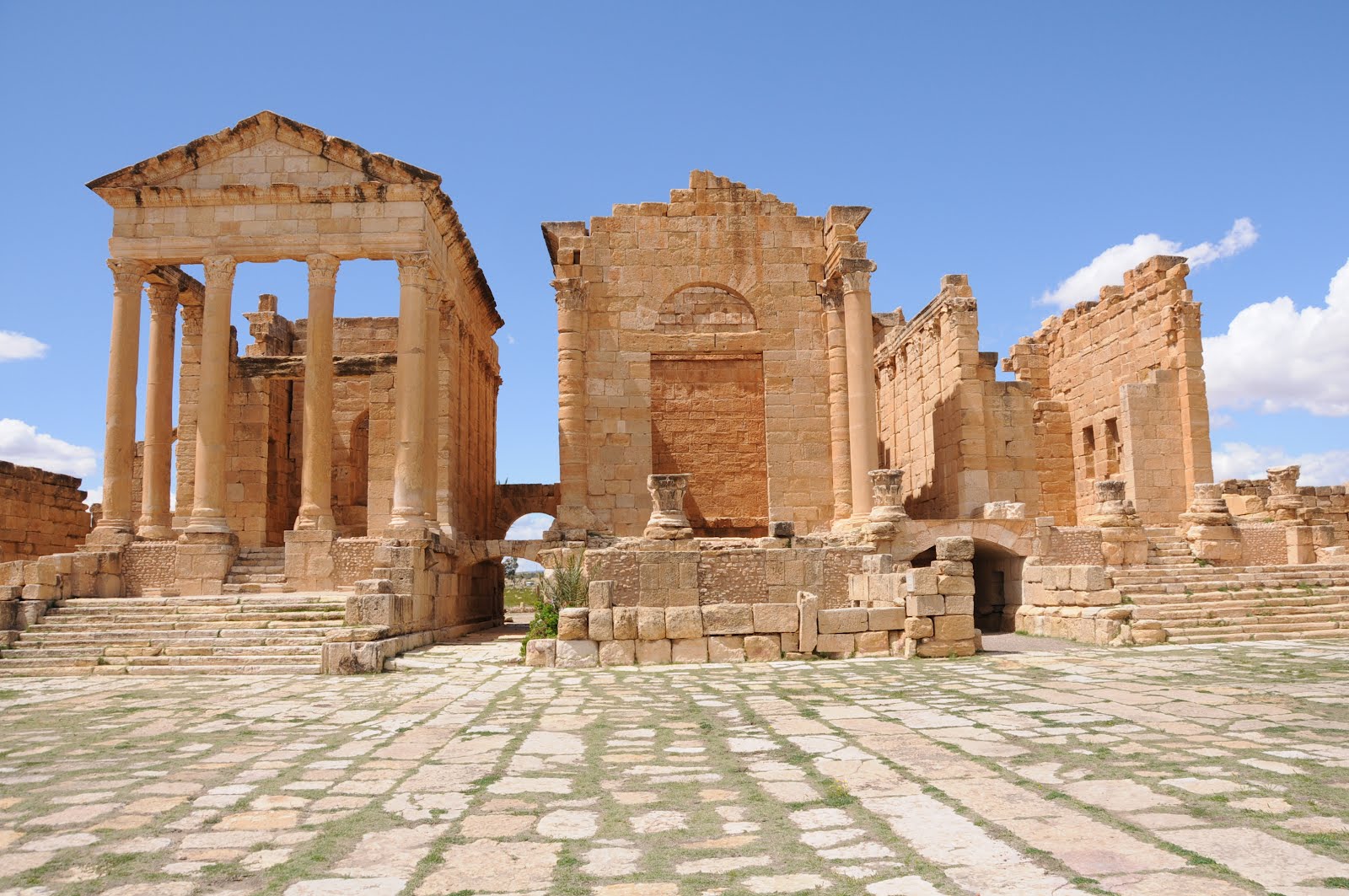
And what did we see under mostly blue skies? The sharp scirocco sped passing clouds and lowered evening temperatures before the summer heat to come but a short shower or two cleared quickly to leave only a few puddles to damp visions of Dido among the cypress and mimosa in the remnants of Punic Carthage, now barely discernible under the overbuilding of conquering Rome. Hannibal lives larger in Livy’s pages than these ruins but the romance of the name cloaks tumbled stone with the glamour of legend while Rome itself is better served in the magnificent ruins at Sbeitla and the glories of the Bardo Museum’s mosaics in Tunis. Here, hares run forever from hounds, bears and tigers pounce and play, putti flit through tesserae skies. Odysseus stands tied to his mast withstanding for all eternity the siren song, as his ship sails on seas teeming with the same cheerful fish that populate the walls of the Sbeitla bathing pools. There is much more to see – Emperor Hadrian’s mighty aqueduct, the great colosseum of El Jem and the World Heritage site of Dougga, the ‘best preserved Roman small town in Africa’, while smaller sites dot the countryside.

In the main square of Tunis, the flags were flying in the breeze as we headed into the maze of the Medina and its various souks and alleys leading to the Grand Mosque at its centre. Nearby ranks of black Mercedes mark the centre of government, the smaller square still surrounded by rolls of razor wire and a strong but apparently relaxed police presence. Later, a drive through the wealthy suburbs around Carthage overlooked by the hilltop Presidential Palace, less stringently guarded since rebellion toppled presidential statues and pushed President Ben Ali into exile in the Gulf, took us to the Mediterranean views, blue doors and white walls of the hilltop town of Sidi Bou Said.

Southwards then to Kairouan and the marvellous 9th century mosque of Oqba Ibn Nafi, its elegant austerity belied by the warmth of the local honey coloured stone in which it was built and rebuilt over the centuries and the mish mash of recycled Roman columns and lintels around its great peaceful courtyard. A particular peace prevailing in post revolution evenings and early mornings when international news reports have rationed the tourist buses and left the souvenir purveyors bereft. The great mosque is said to be the 4th holiest site in Islam although ‘holiest sites’ are a vexed question dependent on the beliefs of the various branches of belief, in this case Sufism. Holiness ratings in any case are a lot less seductive to the unbeliever than the architectural beauty of many ancient mosques.


Kairouan is also the site of the remarkable Aghlabid basins, vast 9th century water cisterns, part of a sophisticated hydro project, built on the orders of Aghlabid prince Abu Ibrahim Ahmed, as well as further important smaller mosques.The Mosque of the Three Gates is tucked away among winding lanes, its facade decorated with carved friezes and the so-called Mosque of the Barber, the Mausoleum of Sidi Sahab, is a favoured place for family ceremonies. Its colourful interior decorated with tiles and fantastical white plaster work like Breton lace, this mosque venerates a companion of the Prophet who saved 3 hairs of his beard for himself. We witnessed one small boy arriving all dressed up and surrounded by ululating female relations for his circumcision,the doctor in a white coat bringing up the rear of the procession.


Further south is Berber, Bedouin and now Star Wars country where wild flowers, scrub and the palms of the oases add the only other colour to the landscape where ruined sand coloured villages disappear slowly into the land they grew from . Declining the horrors of tourist camel rides and drives in caleches pulled by ribby ponies with badly trimmed hooves, we headed into the desert in a 4x4 to visit the defunct Star Wars sets and, nearby, that of the plane crash in The English Patient. George Lucas was inspired by the Ksours, fortified granaries in the area of the real Tataouine, when he created his screen village. There is indeed something other worldly about their honeycomb architecture, small windows and doors in mud built 3 or 4 storey structures, not to mention the extraordinarily spacious troglodyte Berber dwellings round Matmata, like so many hobbit holes, dug deep into the sandy hills of the area.


So finally to Jerba, via the Roman causeway, now flanked by water pipes bringing much needed extra supplies to the island. The capital Houmt Souk still retains a level of local charm with its whitewashed mosques belonging each to less well-known Islamic sects and souks and markets structured much as they must always have been, shops and stalls now catering for tourists with the usual fake designer bags, cheap jewellery and cheaper tee shirts, the occasional higher quality stock, an exception proving the rule. Jerba’s airport bringing in international charter flights is its lifeline and its ruination – for us, it offered a quicker route back to Tunis and on to London avoiding retracing our steps, our time too short to take an alternative route. We would have stayed longer in this smiling country where people are consistently friendly and there is much more to see – further South, into the Sahara, ancient rock carvings, glimpsed on an earlier trip on the Libyan side of the border; going North, much that we have missed both East and West, from Roman cities and Punic remains to Islamic centres and the birds of the Gulf of Gabès and the Ichkeul National Park.


Thursday, 30 June 2011
Not East Africa but Egypt

O dear, what to do when the travel doesn't fit the travel crumbs chapters? I took my daughter to Egypt this month in search of instant post A level archaeological experience since she has decided to study the subject at university. We picked our moment well - nothing like post revolutionary conditions to clear major tourist sites and we had much of Upper Egypt, away from the easiest reach of the Nile tour ships, almost to ourselves. Prices were low and the usual purveyors of every sort of unappealing tourist tat had given up their strenuous attempts at sales in favour of grumbling peacefully over their shishas and waiting for greater stability and the winter season to restore the avid crowds of souvenir seekers and improved livelihoods. Times are hard but even charitable feelings hardly inspire spending on lurid galabiyas and pyramid printed tee shirts or the ubiquitous mass produced scarabs that have none of the delicacy of the tiny blue glazed handmade pieces I found so appealing in the past.

Revolution has done little to improve the Cairo traffic, links in an endlessly moving necklace round the city in which, once enmeshed, there is no law abiding escape, only break outs in bursts of anarchic speed followed by screaming brakes. Few cars or trucks survive unscathed. In high summer from the air, Cairo is a silent city of dust; once outside the pristine new airport buildings, it is a noisy, polluted and irresistible maelstrom where all roads lead eventually to the chaos of Tahrir Square. The solid red bulk of the Egyptian Museum whose antiquities, halls and stairs are coated, like the city, with the dust of decades continues for now to command the square where more modern buildings have been burnt out or, like the Nile Hilton, are being demolished to make way for something new.

The contents of the Museum itself are to move to new premises in Giza in the next year or two which may result in a more orderly experience of Egyptian antiquity with improved lighting and labelling of exhibits. One suspects that some of the current labels have acquired antique status themselves by now although the exhibits themselves, including the best known Tutankhamen collection, are breathtaking under any circumstances. The Museum is always busy and remains relatively so even under current conditions but many of its food, drink and souvenir outlets are closed due to lack of trade and we were able to appreciate the best of the exhibits unhindered by heaving busloads of overheated fellow tourists.

At Saqqara the new and blissfully air conditioned Imhotep Museum by King Djoser's step pyramid is perhaps a promise of things to come in the Egyptian museum world. It is hard to tear oneself away from so much ancient treasure so beautifully preserved, displayed and described in multilingual labelling. There is a short explanatory film in a separate auditorium that is so inky dark as to present considerable danger of falling into it. We had it completely to ourselves, the pyramid and rebuilt funerary complex too and the inevitable carpet factory where we drank mint tea and failed to buy our dues.

The great colossus of Rameses lay still in solitary state in his hall in Memphis, the peace unruffled by noisy crowds and the sphinx of Queen Hatshepsut toasted as she has for vast swathes of time in the sun outside with only a handful of bored guards drinking tea in the shade for company among the broken pillars and other, smaller, faceless sphinxes. Only by the great sphinx itself were there crowds to stare at the broken, mysterious face where pigeons perch like tears on broken cheeks. Camel drivers and horse hirers touted their trips to the panorama above the Pyramids themselves without much enthusiasm and it was possible to take photographs from there uncluttered by more than the odd caleche driving up the road.

In Islamic Cairo and Coptic old Cairo the streets and bazaars were busy only with Cairenes although signs of recent upheavals were unnoticeable beyond burnt out neighbourhood police stations and occasional other buildings that were more likely to be the victims of accident, fire being a regular hazard in a dry and overpopulated city. The great mosques are presently at least frequented mainly by the devout, the dozing or the studious; places of great peace, great majesty and extraordinary architectural beauty, their secrets and styles revealed to us by an architect friend who has spent half a lifetime renovating and restoring the remarkable buildings of the Islamic city. Gateways of ancient caravanserais, a barber, butcher or beauty parlour often tucked into the recesses, opened up visions of earlier lives, travellers and traders. Exquisitely decorated and renovated Sabils, founded by the charitable rich, often women, during Mamluk and Ottoman rules from the 14th to 19th centuries, offered glimpses of changing architectural styles and an echo of those who had drunk the water their cisterns provided, watered animals at their troughs or found free education for their children in their high cool halls.

In the City of the Dead, the living live their busy lives cheek by jowl with the dead as they have always done. These swathes of land laid aside and great buildings created to venerate the dead were always intended to be shared by living descendants and so it is in narrow lanes between great shrines where the village life of small artisans, glassblowers and wood carvers, goats, dogs and thousands of cats continues unabated, improved or not by electricity, trucks and motorcycles, piling plastic rubbish and now overloaded original sewerage systems. In other lanes of the old city, the metal workers and lamp makers, the carvers of intricate wooden screens, the suppliers of shishas and their accoutrements, of leather goods and even the milliners, if such a description can be applied to the makers of most desirable tasselled tarbushes, still worn by academics continue to ply their busy trade. In another tiny alley close to a multitude of mosques an aging Christian cheerfully displays shelves loaded with bottles of whisky and other spirits in his open shop front.

We stayed in the Flamenco Hotel, a rather exhausted business style hotel in Zamalek, part of Gezira Island in the Nile, where embassies and grander hotels cluster near the Cairo Opera House and art deco apartment buildings line the streets along the river. The Flamenco bar and its outside bakery supplying delicious bread and Swiss German pastries are popular with expatriates and Cairenes; the hotel itself verges on the gloomy especially in the cheaper rooms facing away from the Nile where the sun seldom penetrates. Taxis are easily available and cheap - £2 seems to cover a trip almost anywhere which is a treat after London fares and lures the traveller from the economies of the Metro.

We failed rather with restaurant sorties except on a visit to the wonderful early
20th century planned luxuries of Heliopolis where our hosts assured us diamonds were far easier to come by than bread. The Italian restaurant on the Le Pascha Nile boat, moored near our hotel, where the antipasti came highly recommended appeared to have given up in the face of reduced business and the antipasti was neither inspired nor inviting but rather slowly acquiring an air of age and mummification.

After an overnight sleeper journey, including entirely edible dinner and breakfast, to Aswan, we stayed one night in the dingy Marhaba Hotel where we appeared to be the only guests. Perfectly placed for access to Nile boats and feluccas the Marhaba produced a decent lunch but my daughter was propositioned quite determinedly by a receptionist which went some way to putting us off the hotel entirely and we hastened to a the gloriously local Sayida Nafeesa in the bazaar for dinner where more food than 4 of us could have eaten cost us £6 and came with no strings attached.
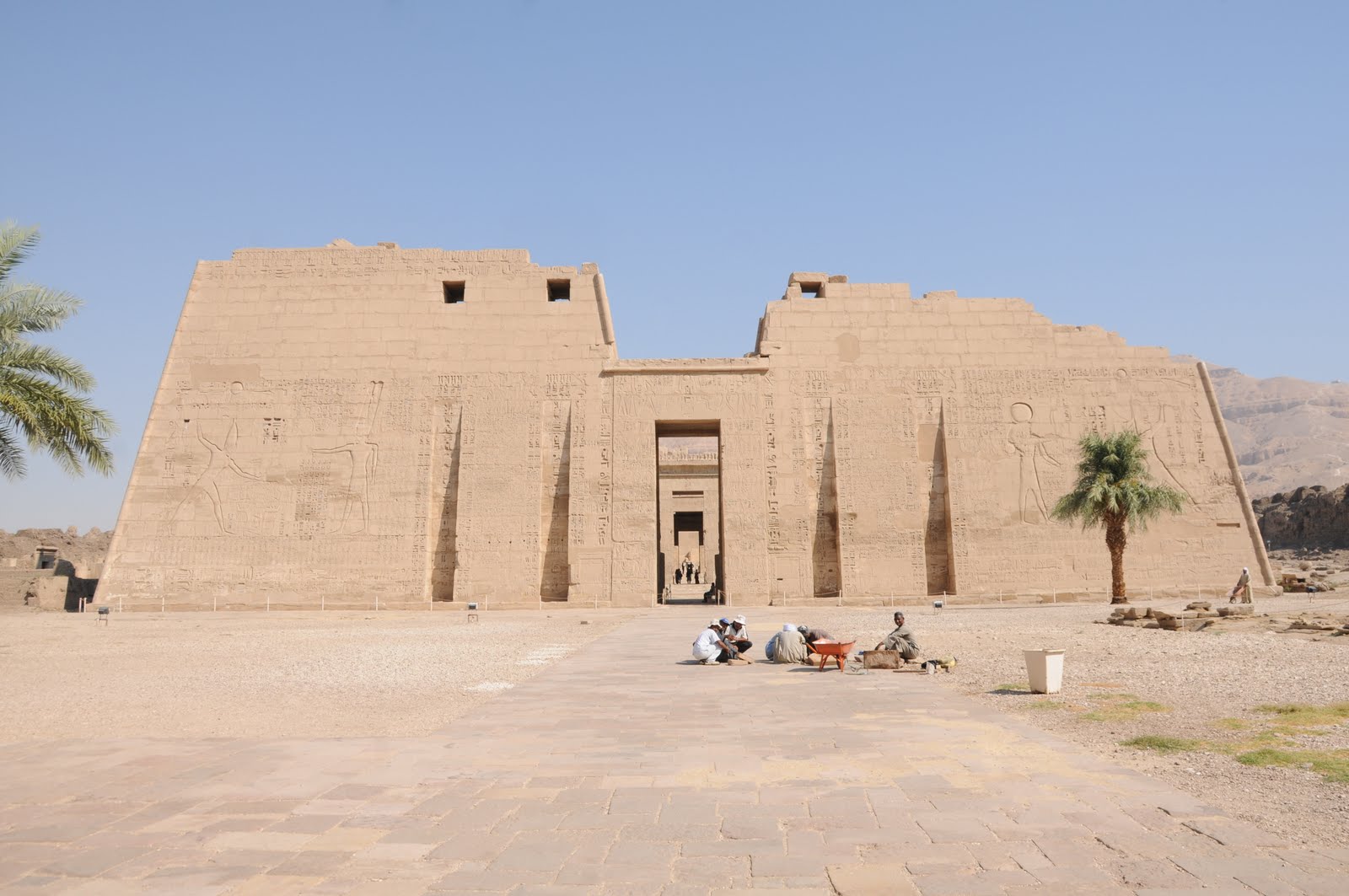

And so a feast of tombs and temples, blessedly for us only Luxor, Karnak and the Valley of the Kings much enlivened by fellow tourists; quieter areas such as the Valleys of the Nobles and the Workers deserted, to our delight. Once embarked on a comfortable Nile ship we failed to join the group congoing round the dining room on the 'Oriental' evening, to change into cocktail dresses for dinner or to attend the galabiya party in the bar and were a great disappointment to the staff who had me down as an alcoholic to boot with a 3 (minute) glasses of Omar Khayyam a night habit. At Kom Ombo and Edfu we were off the boat before the breakfast queues started and back on it before photography involved a shoulder or an elbow edging into every image of a good or vista of fields of magnificent pillars. The only difficulty these days is keeping the son et lumiere fittings out of any picture.

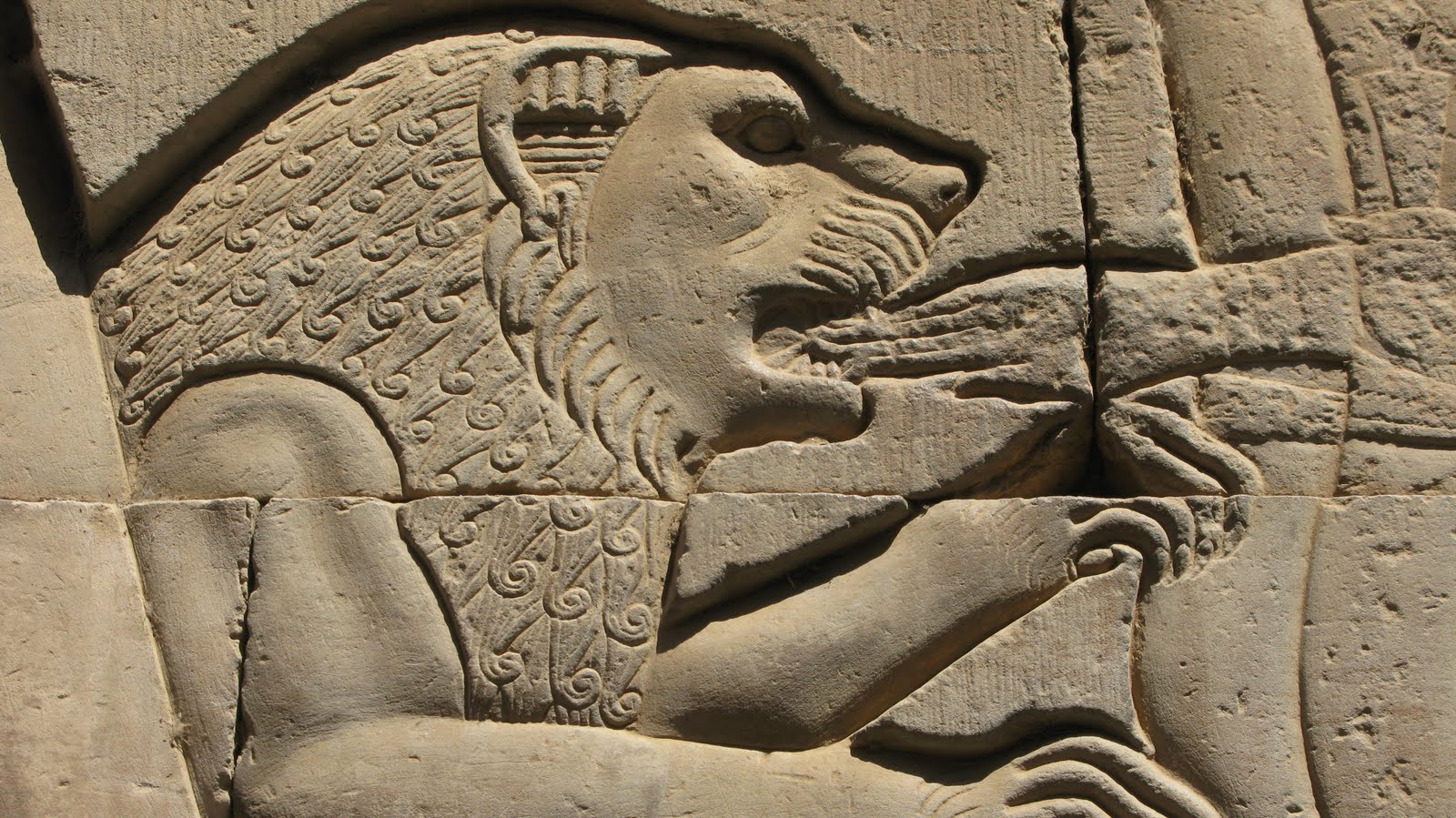
Our brilliant guide, Ahmed (hamadasa15@hotmail.com), had inherited the mantle of the traditional dragoman whose job for 19th and early 20th century tourists was to organise, interpret, arrange transport and money, guide and, if possible be something of a governess to sheeplike charges. Indefatigable himself, Ahmed was prepared to make some allowances for the lesser energies of youth and old age and promised air-conditioned car breaks between more distant sites although we were stringently tested on iconography and hieroglyphic knowledge and woe betide the one who forgot the difference between Hathor and Isis or failed to recognise Anubis as a dog. We did at least manage to take our own photographs. We met one large and bejewelled Italian woman in flowing galabiya, large straw hat and shades, teetering round the temple of Hatshepsut on her wedge heeled sandals with a small guide in tow being instructed on what should be photographed for her with her very small camera.

Monday, 6 September 2010
The tourist travelling to Ethiopia is unlikely to be wholly unaware of the country's recent history or blind to its poverty and the signposts to many years of international aid; the white UN landcruisers; the market place pots and pans manufactured from USAID food tins; the NGO offices in every town. She may, on the other hand, initially bowled over by ancient marvels, quite easily avoid a close view of real hardship and see modernity, growth and increasing wealth exemplified in the great ribbons of new, Chinese built, highway; the bridge construction and the multi-storeyed housing blocks consuming slum areas in old Addis Ababa. A picture supported on the surface at least by a level of equanimity and optimism amongst people who remember when things were a lot worse.
Anyone wishing to understand contemporary Ethiopia better, over and above the staggering beauty of the countryside, its people, wildlife and unique monuments, picking up the country's recent history from the pictures of the 1980s famine still so imprinted on the minds of those old enough to remember, should read Peter Gill’s new book, ‘Famine and Foreigners, Ethiopia since Live Aid' (Oxford University Press).
Gill was the first TV journalist to reach the worst areas of hunger in the 1984 famine and one of those, besides Jonathan Dimbleby, whose television reports changed the whole story of aid and made us all aware of the politically charged imbalances between rich northern givers and poor southern receivers.
His new book is based on in depth research during 2008 and 2009, revisiting the famine affected areas of the eighties; interviewing people ranging from the Prime Minister, opposition leaders, diplomats, international advisers and commentators, to poor farmers, local health workers and, especially, women.
Ethiopia has embarked, more recently than us according to its Julian calendar, on the journey of the 3rd Millenium. For the traveller or the armchair observer wishing to bring the long history of the country up to date beyond its ancient stones, imperial past and the Band Aid legacy, this book provides the essential view; portraying Ethiopia's complicated politics, the lives of its poorest people, the ongoing issues and complications of international aid and the ever present spectre of famine lurking in the wings.
http://www.amazon.co.uk/
Thursday, 29 July 2010
The Hamlin Fistula Hospital
Obstetric fistula is an affliction of poverty and ignorance, the destruction of a woman’s life, the loss of her health and dignity; her hopes for her future role as a mother and as a participating member of the society in which she lives. It is an injury exacerbated by superstition; belief in an influential spirit world tightly interwoven with lives ruled by seasons and by natural fortune or calamity. It is an accident of topography and time; of the vast space and distances of the African and Asian continents and the great void between life in a rural village and in the city. The poor woman may be a citizen of the same country as the rich owner of hotels and shopping malls but she is excluded from medicines and hospitals by her lack of knowledge, untold miles, destitution and fear.
Fistula is a medical condition, most prevalent in the poorest communities in sub-Saharan Africa and Asia, especially Afghanistan. Child or teenage marriage, childbearing before the pelvis is fully developed; malnutrition, small stature and poor health, as well as high parity in older women, are all contributing factors to obstructed labour and obstetric fistula. It ruins the lives of women expected to bear children, usually many children, under the most primitive circumstances. It may be the first of those anticipated children who, stillborn, also condemns a small ill-fed and child-like mother to the outcast status of fistula patients. As she mourns the child who has died, she also discovers that she, and she imagines herself uniquely cursed, has been damaged appallingly by her long and fruitless labour. She is leaking urine, faeces, or both, uncontrollably. She stinks and is to be hidden from view by her family. She brings shame on herself and on them by her loss of the basic physical control learnt as a child. Somehow, this woman has, by conscious or unconscious omission or commission, offended the mysterious shadowy world of the spirits, who need constant propitiation in their ordering of human life according to an unknown design. Religion, whether animist, Christian or Moslem, makes little difference to such deeply ingrained folk beliefs,
In the world where women like most of us live; a world of monitored pregnancies, foetal and maternal monitors and birth plans; it is hard to imagine the gulf that separates us from that other woman, a young girl who understands neither her pregnancy nor the birth process. She can only rely on information from other women in the same position as herself. For us, a labour that lasts five, six days even, is inconceivable – how does a woman survive that except in the hope and expectation of the baby who will be born. That baby will be dead after 48 hours and can only then be expelled when the skull has become soft, fluid enough to squeeze through the bony narrow pelvic passage. Many mothers will die, the others will often wish they had, rather than survive the tearing of bladder or rectum when their dead baby’s head finally crowns and it is pulled from them by untrained hands. Fistula patients are survivors – the ones who escape the UN tables of death in childbirth. In Ethiopia a third of obstructed labours result in maternal death. In a 2005 study, it was estimated that 40,000 women in that country were living with obstetric fistula. In the UK the last case of fistula was at least 100 years ago; in the USA the unique fistula hospital in New York closed in 1895.
The Hamlin Addis Ababa Fistula Hospital is the only unique fistula hospital in the World today. Founded by two young doctors from Australia, the Drs Catherine and Reginald Hamlin in 1959, it has become a centre of care, excellence, outreach, training and new initiative. Now widowed, Dr Catherine Hamlin remains a guiding presence in the hospital, still operating at the age of 85 and teaching the delicate skills she and her husband developed. The doctors and nurses in the hospital and in its growing number of smaller outreach and treatment centres have a grand design and a determination not only to clear the backlog of fistula cases in Ethiopia but in the whole of Africa. They aim to reach other affected areas of the world through training programmes for doctors and nurses from other countries, as well as operating as often as possible themselves.
In the end prevention is the only real and best cure for obstetric fistula and the Hamlin Hospital is working on their dream, a training school for midwives for every rural community. This is still only part of their work. Their patients cannot in many cases ever return home. The repair work of doctors and nurses is not always enough. Even those who are easily cured will return to the hospital to have new babies and must be housed, often 2 to a bed, while they wait for assisted births – they are told to start towards the hospital as soon as they feel their baby move. Others who have nerve damage to their legs, either from the effects of obstructed labour or from years lying in a foetal position attempting to retain their bodily fluids, may need physiotherapy and rehabilitation before they can have an operation. Other still may be too injured ever to return home; they may need stomas, and the hospital must find the money for every stoma bag, several per week. They may be so ill that they require long-term and loving care until they finally die from the kidney or other organ failure that is a result of long-term damage. Many long-term patients are employed as nursing aides; others are trained in handcrafts or as productive members in micro-enterprises at a new rehabilitation/resettlement village, Desta Mender. The Hamlin Hospital refuses no one and constantly works to repair shattered lives as well as medical conditions.
Recently, with the interest of world commentators and the powerful advocacy of media personalities, in particular Oprah Winfrey, the veil of family shame and secrecy surrounding fistula has been lifted. Obstetric fistula has become a term to be understood and to shock women in safer parts of the world into action. We, after all, expect long lives and the facilities to give birth to our children in safety. Meanwhile the Addis Ababa Hospital must find the money to cover the whole circle of birth, life, care and death, including for patients who will be unable to return to a village where there is no hygiene and no water closer than an hour or two’s walk. They must feed and clothe and, they hope, train their chronic patients to be self- sufficient, as nursing aides, tailors, farmers, or cooks. They will remain the responsibility of the hospital for life, deprived of their expectations of family and friends and the familiarity of a native place.
The hospital, with help from around the world, embraces this responsibility as doctors and nurses juggle with medical duties and the endless administrative requirements of building and rebuilding a community as much as a medical facility. Those who die, usually of renal failure, are deeply mourned. Others are, with constant follow up and advice, able to return to husbands and families. They understand that they must seek help in future pregnancies in time to give birth by caesarian section. They have the chance to have live, lovingly greeted babies and are sent home and welcomed again with delight.
No one is ever turned away and women continue to arrive at the hospital – damaged and fearful, they have braved the opprobrium of fellow travelers, borrowed fares from family, church or who knows where, when they hear of the possibility of a cure for their terrible condition. These are young women whose lives are hard enough, their expected life span averages 41 years. They should not have to suffer the loss of life and dignity that women in richer countries know is their right. In the end it is money that counts most in the endless circle of ignorance, superstition, conditions of poverty and in the provision of education, medical expertise, medicines, care and essential services to combat and ultimately end a preventable condition such as obstetric fistula. Supporting the Addis Ababa Hospital and its work is one of the most effective ways to remove the stigma of fistula, the continued existence of which shames us all.
http://www.hamlinfistula.org
Wednesday, 28 July 2010
To the Volcano

‘Only twenty minutes to the top,’ says Tesfa, for the 5th time in the last hour or more and still agile himself, loaded with a growing weight of other people’s kit and cameras.
We scramble painfully over crumbling lava formations following an invisible path ever upwards in the darkness, our small torches lighting only the next unsteady step. 11 Kilometres sounded an easy evening stroll from the bottom but we feel like hobbits at our last gasp struggling across the burnt landscape of Mordor.
Suddenly we are there, the air colder and fresher at the summit, the sky lighter and a cutting wind blowing up dust between a handful of rocky shelters in a roughly improvised campsite. An unseen camel or two groans disagreeably in the lee of a makeshift wall where the dim crouched shapes of tribesmen, sleep upright, with blankets over heads and ancient rifles propped nearby.
Just a steep cliff to climb down, its base hidden in the deeper blackness but we shy away at the top, pit ponies without blindfolds, by this time the spark lost and anticipation for the goal ebbing away. We are exhausted. You can do it if you don't look down and we have been waiting for this moment, our goal the heart of the volcano, the only lava lake in the World. This is Erta Ale, the Mountain of Smoke, the perpetual flame at the centre of the killing heat of the Danakil Desert in Ethiopia
.
‘Can I hold your hand Tesfa?’
Another walk in the dark, crunching across the caldera, wobbling between shifting footholds and sudden holes in the surface, ever weaker torches failing faster even than sore feet and middle-aged knees. Then we are much, much too close to a ragged edge and can only stand swaying, not believing our eyes, dumbfounded but for the ‘O my Gods’ over and over again. Below us a glowing portal to the underworld; a seething, heaving, living lake of fire; a constant tidal swell breaking against the glowing cliffs of the pit as great gouts of bright molten rock bubble up and burst from the burning surface, hurled into the air like sea spray hitting rocks.
We are mesmerised. We may stand here, as smoke clouds billow away from us in the wind, until tomorrow, or the day after, or until the crack of doom. Rivers of fire run randomly across the seething pit in burnished burning ribbons and then die down; quieten down; sigh; build strength for another assault on the walls in an endless attempt to break out of the mountain and pour the contents of hell down its blackened slopes once more.

Saints and Stories

Initial irritation over female exclusion from many of the famous rock hewn churches and monasteries of Northern Tigray was at first sight of their inaccessible perches on the heights of vast rocky outcrops, transformed to sighs of relief. Guide book descriptions of ascents by rope; words and phrases like vertiginous; ‘not really dangerous if you take it slowly’; and, my favourite, ‘it’s amazing the grip a toe can get’; offered additional discouragement. As it is there are enough churches and monasteries all over Northern Ethiopia to keep travellers of both sexes happy for months; plenty require at least a serious scramble to reach them.

Visits to those populating the islands of Lake Tana mean a boat ride that may include a sight of hippopotamuses and enough bird life, including fleets of pelicans, to convert the least ornithologically minded. Fishermen row past in the uncomfortable looking semi-submerged papyrus boats that have been used here for millennia. Contemporary life in Ethiopia often seems barely a step ahead of the life and legends so gloriously painted on the walls of Orthodox churches and so alive to those who worship there.
Lake Tana is the largest in Ethiopia with monasteries and churches on at least 20 of its 37 islands. One of the most famous, open to all, is Ura Kidane Meret, actually on the Zege peninsula but more easily reached from the busy modern town of Bahir Dar by boat. Walking up the rocky path to the 16th and 17th century monastery, we meet al l the monks heading for a funeral on another island. Funerals in Ethiopia involve as many people as possible including the merest acquaintances and certainly all available ecclesiastics. The church, centre of the monastery buildings is a round building with stone and mud walls and a corrugated iron roof replacing the original thatch. The sweep of the bamboo ceiling as it curves round the circular ambulatory is like a great Noah’s Ark but the true treasure of the church is its interior, revealed when a flowered curtain is drawn aside.
It would take hours to see every detail and years to understand every story of the Orthodox canon, inspiration for the decoration of hundreds of the estimated 50,000 Ethiopian Orthodox churches and the greatest delight to the tourist. The truth is that they can be read like cartoons and are as lively as moving pictures; moving indeed in their faith and sincerity however gloriously far-fetched the stories behind them. It is easier, after a few days wondering how on earth first millennium builders achieved the monolithic rock churches of Lalibela, to suspend disbelief and accept tales of architecturally inspirational trips to heaven by their founder and an angelic night shift. After that the saints’ lives follow easily enough. After all, if you had stood praying on one leg for somewhere between 7 and 22 years, depending on who you believe, the spare limb might very well fall off. If as well you had only eaten one seed a year delivered by a bird you might think you deserved God rewarding such devotion with no less than three pairs of wings and, in some paintings, another for the detached leg.

A great favourite of the painters is Gebre Manfus Kiddus. Preaching one day to the animals in the desert, he found a bird dying of thirst. Lifting it, he allowed it to drink a tear from his eye and is usually depicted with a revived black bird flying round his head as he stands surrounded by lions and tigers. There are varying views of his hairy apparel; some say it is his beard, others furs; the beard is obviously the most likely. Ura Kidane Meret is no exception in its equally splendid depictions of the baddies of the bible and more alternative religious stories. They are, with the exception of the devil who has two, always painted with one eye only; thus Judas Iscariot is quickly spotted at the Last Supper. Somewhat unsuccessful attempts are made to make the wicked look so as they put martyrs gruesomely to death and dismember well-known saints by unexpected means in a most cheerful fashion.
Back on the lake, jets of the Ethiopian airforce overhead are doing their best with the sound barrier; a dramatic pointer to a faster, less spiritually imaginative world. In Bahir Dar at the basic but charming Ghion hotel, where weaver birds with bandit eye masks steal the breakfast off your plate, modernity has been defeated by a 24 hour power strike. Good luck as it turns out for the tourist. Lake Tana is the source of the Blue Nile and the famous Blue Nile falls, the Tis Isat or Water that Smokes, are nearby, now a mere trickle of their former self due to an upstream hydro-electric plant that supplies most of Northern Ethiopia. The total lack of any water in the hotel caused by no electricity ceased to matter as we walked towards the thunder of the falls in full tumbling spate. Due to the power shut down, the gates have had to be opened, a privilege nowadays only granted to occasional visiting heads of state.

Subscribe to:
Posts (Atom)